
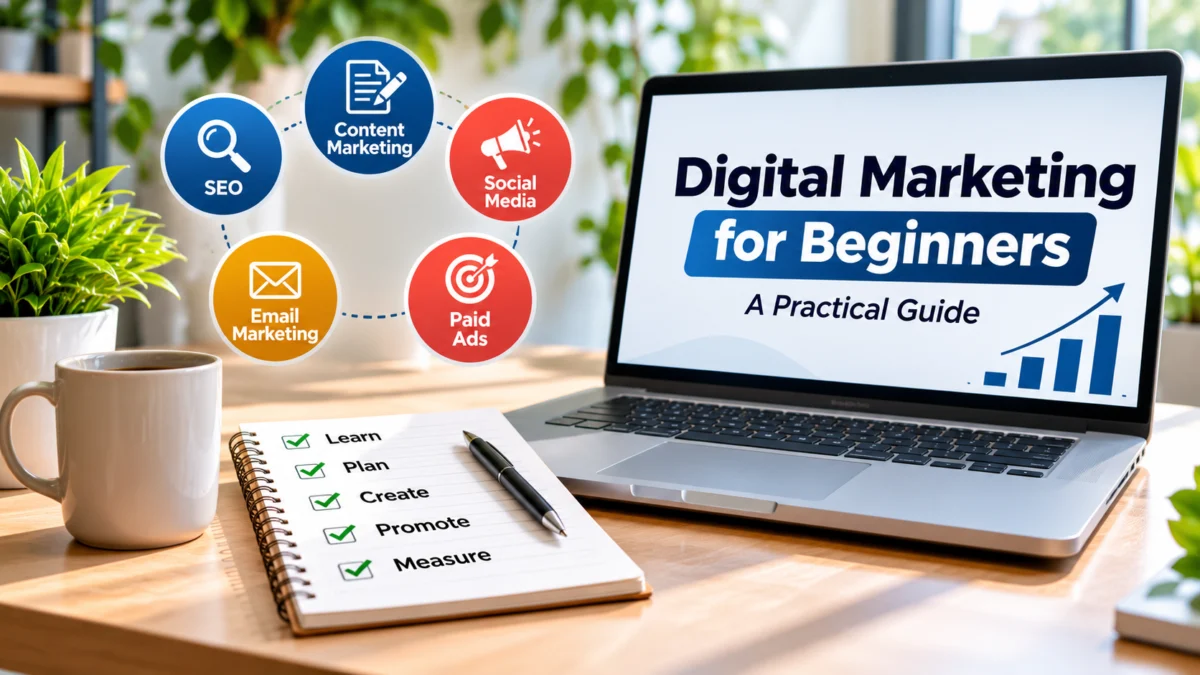
Digital marketing helps a business reach people through search engines, websites, email, social networks, online video and paid advertising. Beginners do not need to use every channel at once. The strongest starting point is to understand the customer, choose one clear business goal and build a simple plan that can be measured and improved.
1. Set a clear marketing goal
Start with the result the business needs. Examples include generating qualified enquiries, selling a product, getting more bookings, growing an email list or increasing repeat purchases. Avoid goals such as “get more followers” unless audience growth is directly connected to a business outcome.
Make the goal specific and time-bound. Record the current baseline, choose a target and decide how success will be measured. For example, a local service business might aim to generate 20 qualified enquiry forms in 60 days, while an online shop might focus on profitable purchases rather than visits alone.
2. Understand the people you want to reach
Describe your ideal customer using real business knowledge: the problem they need solved, what they compare before buying, common objections, budget range and the questions they ask. Review customer conversations, sales enquiries, support tickets, product reviews and on-site search terms. These sources are more useful than inventing a detailed customer persona from assumptions.
Write a simple value proposition that explains who you help, what problem you solve and why your offer is worth considering. Use the same clear message across your website, landing pages and campaigns.
3. Understand the customer journey before choosing channels
People rarely move from first hearing about a business to buying in one step. A simple customer journey helps you decide what information to publish and where to publish it.
| Stage | What the customer needs | Useful marketing content |
|---|---|---|
| Awareness | Understand a problem or discover an option | Helpful social posts, search articles, short videos and local discovery |
| Consideration | Compare choices and build confidence | Service details, product demonstrations, comparisons, reviews and case studies |
| Conversion | Take the next step with confidence | Clear prices or quote process, booking details, contact options and focused landing pages |
| Retention | Get value after the purchase | Helpful onboarding, support, email updates and relevant follow-up |
Map one real customer journey for your main product or service. Note the questions people ask at each stage and make sure the website or channel gives them a clear answer. This is more useful than posting randomly or creating content only because a platform is promoting a new feature.
4. Choose the right digital marketing channels
Choose channels based on customer behaviour, buying intent, resources and the time available to maintain them. A small business can begin with one main acquisition channel and one channel for follow-up.

| Channel | Best suited to | Useful first action |
|---|---|---|
| SEO | People actively searching for an answer or service | Publish helpful service and problem-solving pages |
| Content marketing | Explaining a product, building trust and answering questions | Create a practical guide, comparison or tutorial |
| Social media | Community, discovery and ongoing engagement | Choose one platform your audience already uses |
| Email marketing | Building relationships with people who opt in | Offer a useful sign-up incentive and a welcome email |
| Paid advertising | Testing demand or reaching a defined audience quickly | Start with one measurable campaign and a capped budget |
| Local marketing | Businesses serving a defined town, city or service area | Complete and maintain the Google Business Profile |
For practical channel combinations, read our guide to digital marketing strategies for business growth.
5. Build a reliable website and measurement setup
Your website should make the next step obvious. Give every important page a clear purpose, explain the offer in plain language, show accurate contact details and make forms usable on mobile devices. Check page speed, accessibility, navigation, trust signals and whether the visitor can complete the intended action without confusion.
Install and test analytics before launching campaigns. In Google Analytics 4, identify the events that represent meaningful actions, such as a completed enquiry, purchase, booking or qualified sign-up. Mark the relevant events as key events so you can review important user actions in reports. Google explains how to create and mark key events.
Use Google Search Console to monitor search queries, clicks, indexing and technical search issues. Add campaign parameters to links used in email and social campaigns so that traffic sources can be identified consistently.
6. Publish content that answers real questions
Build a small content plan around the questions customers ask before and after a purchase. Useful formats include tutorials, product or service comparisons, pricing explanations, case studies, checklists and answers to common objections. Each piece should have a clear audience and a reason to exist beyond adding another page to the website.

For video, start with a phone, a quiet location and a clear explanation. Demonstrate one feature, answer one customer question or show one step in a process. Clear audio, useful information and a visible next step matter more than expensive equipment.
Use search terms naturally in page titles, headings, descriptions and image alt text where they accurately describe the content. Avoid repeating keywords unnaturally. Google recommends creating helpful, reliable, people-first content that adds value for visitors. Review its people-first content guidance when planning articles.
7. Set a realistic budget and test carefully
Separate costs into website and content production, software, advertising and people or freelance support. Set a test budget you can afford to lose, decide what result would justify continuing and check performance before increasing spend. Do not copy another business’s daily budget because margins, competition and conversion rates differ.
For paid campaigns, make sure the landing page matches the advertisement, conversion tracking works and the business can fulfil the demand. Review search terms, placements, audience quality and actual leads or sales, not just impressions and clicks.
8. Understand the basic cost and return metrics
Beginners do not need a complicated dashboard, but they should know what it costs to generate a useful enquiry or acquire a customer. Start with a few simple calculations and use the same definitions each time.
- Cost per lead: Campaign spend divided by the number of leads generated.
- Customer acquisition cost: The relevant marketing and sales cost divided by the number of new customers acquired during the same period.
- Return on ad spend: Revenue attributed to advertising divided by advertising spend. This is a revenue ratio, not the same as profit.
- Conversion rate: The share of relevant visitors or leads who complete the action you are measuring. State the denominator clearly when comparing results.
For example, if a campaign spends ₹10,000 and produces 20 qualified enquiries, its advertising cost per qualified lead is ₹500. If four of those enquiries become customers, the advertising spend per acquired customer is ₹2,500. This example excludes other sales and operating costs, so it should not be treated as profit or a universal benchmark.
Compare these figures with your gross margin, customer lifetime value, fulfilment capacity and the quality of the leads. A campaign with cheaper leads is not necessarily better if those leads rarely become customers.
8. Understand the basic cost and return metrics
Beginners do not need a complicated dashboard, but they should know what it costs to generate a useful enquiry or acquire a customer. Start with a few simple calculations and use the same definitions each time.
- Cost per lead: Campaign spend divided by the number of leads generated.
- Customer acquisition cost: The relevant marketing and sales cost divided by the number of new customers acquired during the same period.
- Return on ad spend: Revenue attributed to advertising divided by advertising spend. This is a revenue ratio, not the same as profit.
- Conversion rate: The share of relevant visitors or leads who complete the action you are measuring. State the denominator clearly when comparing results.
For example, if a campaign spends ₹10,000 and produces 20 qualified enquiries, its advertising cost per qualified lead is ₹500. If four of those enquiries become customers, the advertising spend per acquired customer is ₹2,500. This example excludes other sales and operating costs, so it should not be treated as profit or a universal benchmark.
Compare these figures with your gross margin, customer lifetime value, fulfilment capacity and lead quality. A campaign with cheaper leads is not necessarily better if those leads rarely become customers.
A simple 30-day digital marketing starter plan
- Days 1-7: Define the goal, customer, offer and one primary conversion. Review the website and note the current baseline.
- Days 8-14: Fix key landing pages, analytics events, contact paths and mobile usability.
- Days 15-21: Publish one high-value guide or landing page and prepare a small set of social or email content to distribute it.
- Days 22-30: Review traffic quality, enquiries, purchases and user feedback. Keep what works, improve weak pages and plan the next test.
9. Build a simple weekly marketing routine
A repeatable routine helps beginners stay consistent without spending every day creating content. Adjust the schedule to your team size and the needs of your customers.
- Start of the week: Review enquiries, sales, website performance and customer questions. Choose one priority for the week.
- Midweek: Publish one useful piece of content or improve an important page. Share it through the channel your audience uses.
- Follow-up: Reply to genuine questions, respond to opted-in email enquiries and make sure leads receive a timely response.
- End of the week: Check what generated qualified actions, record what you learned and decide what to repeat or improve.
Consistency matters more than maintaining an unrealistic daily posting target. A useful article, an accurate service page or a clear product demonstration can continue helping customers after the day it is published.
Common beginner mistakes to avoid
- Trying to manage every social platform before understanding where customers spend time.
- Buying traffic before conversion tracking and landing pages are ready.
- Measuring followers or page views without checking leads, sales or retention.
- Publishing generic or AI-generated material without fact-checking, original insight or practical value.
- Changing multiple campaign elements at once, making it difficult to learn what caused a result.
Frequently asked questions
Can I start digital marketing with a small budget?
Yes. Start with useful website content, a maintained business profile where relevant, organic social distribution and email to people who have chosen to hear from you. Spend on advertising only after you can measure the outcome.
Which digital marketing channel should a beginner choose first?
Choose the channel that matches customer intent. Search can work for people already looking for a solution; social content can help with discovery; email can support repeat contact. The best first channel depends on the business and audience.
How long does digital marketing take to show results?
Paid campaigns can generate visits soon after launch, but profitable results depend on the offer, targeting and conversion experience. SEO and content usually require consistent work and time before their impact can be judged.
Related reading
Continue with our guide to AI in digital marketing or explore the 10 digital marketing strategies for business growth.
3 thoughts on “Digital Marketing for Beginners: A Practical Guide”