
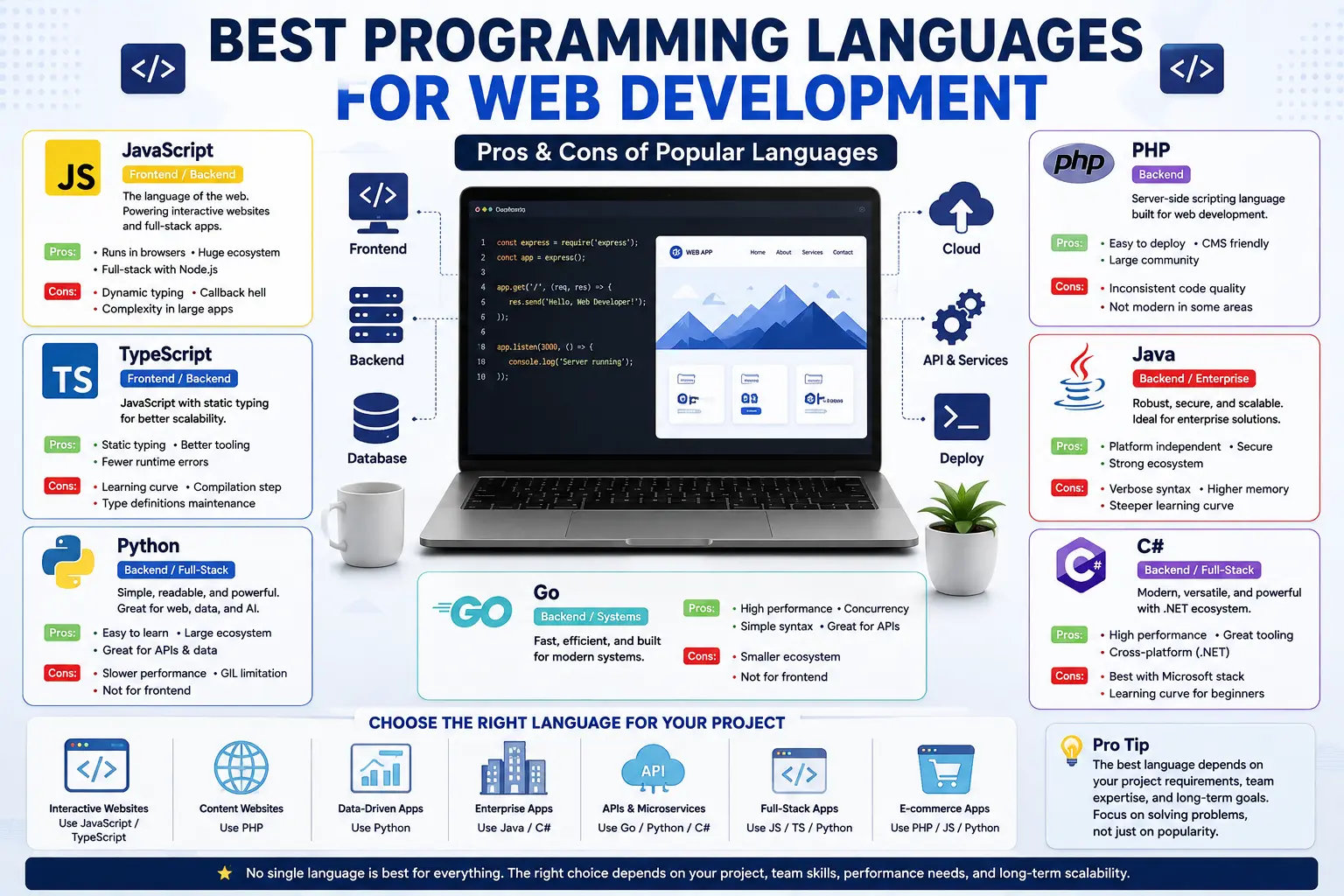
Best programming languages for web development depend on what you are building, where the code will run, how the application will scale, and what skills your development team already has. JavaScript remains central to browser-based development, while TypeScript has become an important option for larger JavaScript projects. Python, PHP, Java, C#, and Go are also strong choices for different backend and full-stack requirements.
There is no single language that is best for every website or web application. A developer building an interactive frontend has different requirements from a team creating an enterprise platform, API service, content management system, or high-concurrency backend.
The right choice should therefore be based on the project’s requirements rather than popularity alone.
What Makes a Programming Language Good for Web Development?
A programming language becomes useful for web development when it has practical support for the tasks required by modern websites and applications.
Important factors include:
- Browser or server support
- Framework availability
- Package ecosystem
- Developer tooling
- Documentation
- Security practices
- Performance requirements
- Database integration
- API development
- Testing tools
- Deployment options
- Long-term maintainability
- Availability of developers
Technical documentation also matters. The 2025 Stack Overflow Developer Survey reported that technical documentation was the most-used learning resource among respondents, with nearly 68% reporting that they used it during the previous year.
For web development specifically, MDN describes JavaScript as one of the core web technologies alongside HTML and CSS, with JavaScript responsible for dynamic behavior and interactive functionality in web pages.
Best Programming Languages for Web Development
The following languages cover several major web development use cases.
| Language | Main Web Use | Key Strength | Main Limitation |
| JavaScript | Frontend, backend, full-stack | Runs in browsers and has a broad ecosystem | Large ecosystem can increase complexity |
| TypeScript | Frontend, backend, full-stack | Static typing on top of JavaScript | Requires compilation/tooling |
| Python | Backend, APIs, automation | Readable syntax and broad ecosystem | Not usually the first choice for browser code |
| PHP | Server-side websites | Built specifically around web development | Legacy code quality varies between projects |
| Java | Enterprise backend | Mature ecosystem and strong tooling | More verbose than some alternatives |
| C# | Web apps, APIs, enterprise | Strong .NET ecosystem | Best fit often depends on .NET expertise |
| Go | APIs, services, backend systems | Concurrency and efficient deployment | Smaller web ecosystem than JavaScript or PHP |
JavaScript
JavaScript is one of the most important languages for web development because it runs directly in modern browsers and can also be used outside the browser.
MDN describes JavaScript as a programming language commonly used to create dynamic behavior on web pages. It can handle tasks such as updating page content, controlling multimedia, creating animations, and responding to user interactions.
JavaScript can also be used on the server through environments such as Node.js, allowing developers to use the same core language across frontend and backend applications.
Pros of JavaScript
- Runs directly in browsers.
- Supports interactive web interfaces.
- Has a large ecosystem.
- Works with many frontend frameworks and libraries.
- Can be used for backend development.
- Suitable for full-stack development.
- Has extensive learning resources.
Cons of JavaScript
- The ecosystem contains many tools and frameworks.
- Large projects require careful architecture.
- Dynamic typing can allow certain errors to appear during runtime.
- Dependency management requires attention.
- Browser compatibility still needs testing for some features.
Best For
JavaScript is a strong choice for interactive websites, frontend applications, full-stack projects, dashboards, e-commerce interfaces, and applications that need substantial browser-side functionality.
TypeScript
TypeScript builds on JavaScript by adding static type checking and other development features. It is designed to produce JavaScript that can run in environments supporting JavaScript.
For teams building larger applications, TypeScript can make data structures, function parameters, interfaces, and APIs more explicit.
The important distinction is that TypeScript does not replace JavaScript at runtime. It is commonly transformed into JavaScript as part of the development process.
Pros of TypeScript
- Adds static typing to JavaScript development.
- Helps document expected data structures.
- Works with the JavaScript ecosystem.
- Suitable for large codebases.
- Supports modern frontend and backend frameworks.
- Can improve editor and development-tool feedback.
Cons of TypeScript
- Adds a build or compilation step.
- Requires developers to understand its type system.
- Type definitions can require maintenance.
- Beginners may find it more complex than basic JavaScript.
Best For
TypeScript is particularly useful for large frontend applications, full-stack products, APIs, SaaS platforms, and teams that want stronger type checking during development.
Python
Python is a general-purpose programming language used across web development, automation, data processing, artificial intelligence, and other areas.
Python is commonly used for backend web development through frameworks such as Django and Flask. Its syntax is relatively concise, which can make application logic easier to read and maintain when projects follow good development practices.
Python is also useful when a web application needs to interact with data-processing, machine-learning, or automation systems.
Pros of Python
- Readable syntax.
- Broad ecosystem.
- Strong backend framework options.
- Useful beyond web development.
- Works well with data and AI tooling.
- Suitable for APIs and server-side applications.
Cons of Python
- Browser-side development is generally handled by JavaScript or related technologies.
- Some workloads require careful performance planning.
- Python applications still require appropriate architecture, caching, database design, and deployment practices.
- Framework and dependency choices can affect maintainability.
Best For
Python is a strong option for backend services, APIs, data-driven applications, automation-heavy websites, and applications that connect web functionality with AI or data-processing workloads.
PHP
PHP remains a web-focused server-side programming language. The official PHP documentation describes it as an open-source general-purpose scripting language that is especially suited to web development and can be embedded into HTML.
PHP is widely associated with content-driven websites and CMS platforms, including WordPress, but it can also be used to build custom server-side applications.
Pros of PHP
- Designed with web development as a major use case.
- Straightforward deployment options.
- Large ecosystem.
- Strong CMS integration.
- Supports server-side HTML generation.
- Suitable for websites and APIs.
- Available across many hosting environments.
Cons of PHP
- Older codebases can contain inconsistent patterns.
- Framework and application architecture still require careful planning.
- Large applications need disciplined dependency and code management.
- Developers need to understand modern PHP practices rather than relying on legacy patterns.
Best For
PHP is a practical choice for content management systems, business websites, dynamic websites, e-commerce platforms, and server-rendered web applications.
For websites built around WordPress, PHP knowledge is particularly useful for theme, plugin, and backend customization.
Java
Java is a mature programming language with a long history in enterprise software and backend development.
Java web applications are commonly built using frameworks and platforms such as Spring. It is suited to systems that require structured architecture, mature development tooling, database integration, authentication, APIs, and enterprise workflows.
Pros of Java
- Mature ecosystem.
- Strong enterprise adoption.
- Extensive tooling.
- Strong type system.
- Suitable for large backend applications.
- Broad database and API support.
- Well-established testing and deployment practices.
Cons of Java
- Can require more code than some modern alternatives.
- The ecosystem can be complex for beginners.
- JVM configuration and application architecture require technical knowledge.
- Smaller projects may not need its full enterprise-oriented ecosystem.
Best For
Java is a strong option for enterprise applications, financial systems, large backend platforms, APIs, and organizations with established Java teams.
C#
C# is closely associated with the .NET ecosystem and can be used for web applications and APIs through ASP.NET Core.
Microsoft’s current ASP.NET Core documentation describes the platform as a framework for building web apps and services that are fast, secure, cross-platform, and cloud-based. It supports web APIs, MVC applications, real-time applications, and interactive client-side applications.
Pros of C#
- Strong .NET ecosystem.
- Suitable for web APIs and applications.
- Good IDE and development-tool support.
- Cross-platform ASP.NET Core development.
- Strong typing.
- Suitable for enterprise systems.
- Supports cloud-based application development.
Cons of C#
- The ecosystem can be extensive for beginners.
- Best value often comes when the team already uses .NET.
- Some projects may not require the broader .NET platform.
- Framework updates and dependencies need ongoing maintenance.
Best For
C# is suitable for enterprise web applications, APIs, internal business systems, cloud applications, and teams already working within Microsoft’s technology ecosystem.
Go
Go is a statically typed, compiled language designed with networked and multicore systems in mind.
The official Go project provides dedicated resources for web development, including HTTP services, web templates, database connectivity, and RESTful API development.
Go’s concurrency model and compiled binaries make it a useful option for backend services where efficient resource use and straightforward deployment are important.
Pros of Go
- Compiled language.
- Strong concurrency support.
- Built-in HTTP capabilities.
- Useful for APIs and backend services.
- Cross-platform support.
- Relatively simple language design.
- Suitable for cloud and distributed systems.
Cons of Go
- Smaller web ecosystem than JavaScript.
- Fewer traditional CMS options.
- Developers may need additional components for application features.
- Not generally used as the primary browser scripting language.
Best For
Go works well for APIs, backend services, microservices, cloud applications, networking tools, and systems where concurrency and deployment efficiency matter.
Which Programming Language Is Best for Frontend Development?
For browser-based frontend development, JavaScript and TypeScript are the most relevant choices in this list.
JavaScript directly operates in the browser and is part of the core web technology stack described by MDN.
TypeScript provides an additional type system and is commonly used in larger JavaScript-based applications.
HTML and CSS remain essential even when JavaScript or TypeScript is used. A modern frontend is normally built from all three layers:
- HTML: Structure and meaning
- CSS: Presentation and layout
- JavaScript/TypeScript: Behavior and application logic
Choosing JavaScript or TypeScript does not remove the need to understand HTML and CSS.
Which Language Is Best for Backend Development?
The answer depends on the application.
Python works well for data-heavy applications, APIs, automation, and applications connected to AI workflows.
PHP is practical for server-rendered websites, CMS platforms, and many business websites.
Java fits large enterprise systems and organizations that already use the Java ecosystem.
C# is a strong option for organizations using .NET and Microsoft technologies.
Go is useful for APIs, network services, and backend systems where concurrency and deployment efficiency are important.
JavaScript/TypeScript can also handle backend development through JavaScript runtimes and frameworks.
There is therefore no universal backend winner.
Programming Languages Comparison for Web Development
| Requirement | Recommended Options |
| Interactive frontend | JavaScript, TypeScript |
| Full-stack JavaScript ecosystem | JavaScript, TypeScript |
| Data-driven backend | Python |
| AI-connected web application | Python + JavaScript/TypeScript |
| WordPress development | PHP |
| Content-heavy websites | PHP |
| Enterprise applications | Java, C# |
| Microsoft ecosystem | C# |
| APIs and microservices | Go, Java, C#, Python, TypeScript |
| High-concurrency backend services | Go |
| Beginner-friendly backend learning | Python |
| Large frontend application | TypeScript |
These are practical starting points rather than strict rules. Architecture, team expertise, hosting, existing systems, and product requirements can change the best choice.
How to Choose the Right Programming Language
1. Define the Project
Start by identifying what you are building.
A blog, business website, SaaS application, e-commerce platform, API, dashboard, or real-time application can require different technical choices.
2. Identify Frontend Requirements
If the project needs complex browser interaction, JavaScript or TypeScript will usually be part of the stack.
3. Define Backend Requirements
Consider authentication, databases, APIs, background processing, integrations, and expected traffic.
4. Evaluate the Existing Team
A language that your team already understands can reduce training and maintenance requirements.
5. Consider the Ecosystem
Check available frameworks, libraries, testing tools, hosting options, integrations, documentation, and community support.
6. Consider Performance Requirements
Do not select a language based only on benchmark numbers. Evaluate the entire system, including database queries, network requests, caching, infrastructure, and application architecture.
7. Consider Long-Term Maintenance
A language should be evaluated over the expected life of the project. Developer availability, dependency management, documentation, testing, security updates, and deployment processes all matter.
For broader web development planning, see the latest web development trends.
Programming Language vs. Web Framework
A programming language and a web framework are not the same thing.
For example:
- JavaScript → React, Next.js, Express, Node.js ecosystem
- TypeScript → Angular, NestJS, Next.js and other JavaScript frameworks
- Python → Django, Flask, FastAPI
- PHP → Laravel, Symfony
- Java → Spring
- C# → ASP.NET Core
- Go → Gin, Echo, standard
net/http
The language provides the programming foundation, while the framework supplies structures and tools for building particular types of applications.
This distinction matters when comparing technologies. A language should not be judged solely by the capabilities of one framework.
How Programming Languages Affect SEO
The programming language itself does not determine whether a website ranks well in search results.
SEO depends on implementation.
A website built with PHP can have strong technical SEO. A JavaScript application can also be search-friendly when rendering, navigation, content accessibility, performance, URLs, metadata, and structured data are implemented correctly.
Important technical areas include:
- Crawlable URLs
- Accessible content
- Descriptive page titles
- Useful meta descriptions
- Internal linking
- Structured data
- Mobile usability
- Page performance
- Server response
- Canonical URLs
- XML sitemaps where appropriate
For a broader technical foundation, review how to build a fast SEO-friendly website.
For on-page implementation, see the on-page SEO techniques guide.
Frequently Asked Questions
What is the best programming language for web development?
There is no single best language for every web project. JavaScript and TypeScript are strong choices for frontend and full-stack applications, while Python, PHP, Java, C#, and Go each fit different backend and application requirements.
Which programming language is best for beginners in web development?
Python can be approachable for learning programming fundamentals, while JavaScript is important for anyone who wants to understand browser-based web development. A beginner interested specifically in frontend development should learn HTML, CSS, and JavaScript.
Is JavaScript still important for web development?
Yes. JavaScript remains a core web technology used to add dynamic behavior and interactive functionality to web pages. MDN documents JavaScript as a major part of the web platform alongside HTML and CSS.
Is TypeScript better than JavaScript?
TypeScript is not universally better. It adds static typing and development features that can be valuable for larger applications. JavaScript remains simpler for projects where those additional capabilities are unnecessary.
Is Python good for web development?
Yes. Python is widely used for backend web development, APIs, automation, data applications, and systems that integrate web functionality with AI or data-processing workloads.
Is PHP still good for web development?
Yes. PHP remains specifically suited to server-side web development, and its official documentation continues to position it as a web-focused scripting language.
Is Java good for web development?
Java is well suited to enterprise web applications, backend services, APIs, and systems that require mature tooling, structured architecture, and a large ecosystem.
Is C# good for web development?
Yes. C# with ASP.NET Core can be used to build web applications, APIs, MVC applications, real-time applications, and cloud-based services.
Is Go good for web development?
Go is a strong choice for backend services, APIs, network applications, and cloud systems. The official Go documentation provides dedicated web-development resources and REST API tutorials.
Which programming language should I learn for full-stack development?
JavaScript or TypeScript is a practical route because the same ecosystem can cover frontend and backend development. Another option is to pair a frontend language with a backend language such as Python, PHP, Java, C#, or Go.
Does the programming language affect website SEO?
The language itself does not determine search rankings. The technical implementation matters more, including crawlability, rendering, page performance, content accessibility, URLs, metadata, internal linking, and structured data.
Conclusion
The best programming languages for web development depend on the project rather than a single popularity ranking.
JavaScript remains essential for browser-based interaction, while TypeScript is a strong choice for larger JavaScript applications. Python works well for backend systems, APIs, automation, and data-connected applications. PHP remains a practical web-focused option, especially for CMS-driven websites. Java and C# are established choices for enterprise applications, while Go is well suited to APIs, backend services, and systems where concurrency and efficient deployment are important.
For beginners, the best language is often the one that matches the type of development they want to practice. For businesses, the decision should consider existing infrastructure, developer skills, project requirements, maintenance, security, hosting, performance, and long-term scalability.
The most effective technology choice is the one that solves the actual problem without introducing unnecessary complexity.