

Digital marketing works best when the channels, message and customer experience support one another. A business does not need to publish on every social platform or buy every advertising tool. It needs to understand its customers, choose a realistic mix of channels and measure whether the work produces qualified enquiries, sales and repeat business.
This guide explains ten practical digital marketing strategies for businesses of different sizes. Each strategy includes what to do, what to measure and how it fits into a wider growth plan. The examples are starting points, not guaranteed results: performance depends on your offer, audience, competition, margins and ability to serve the demand.
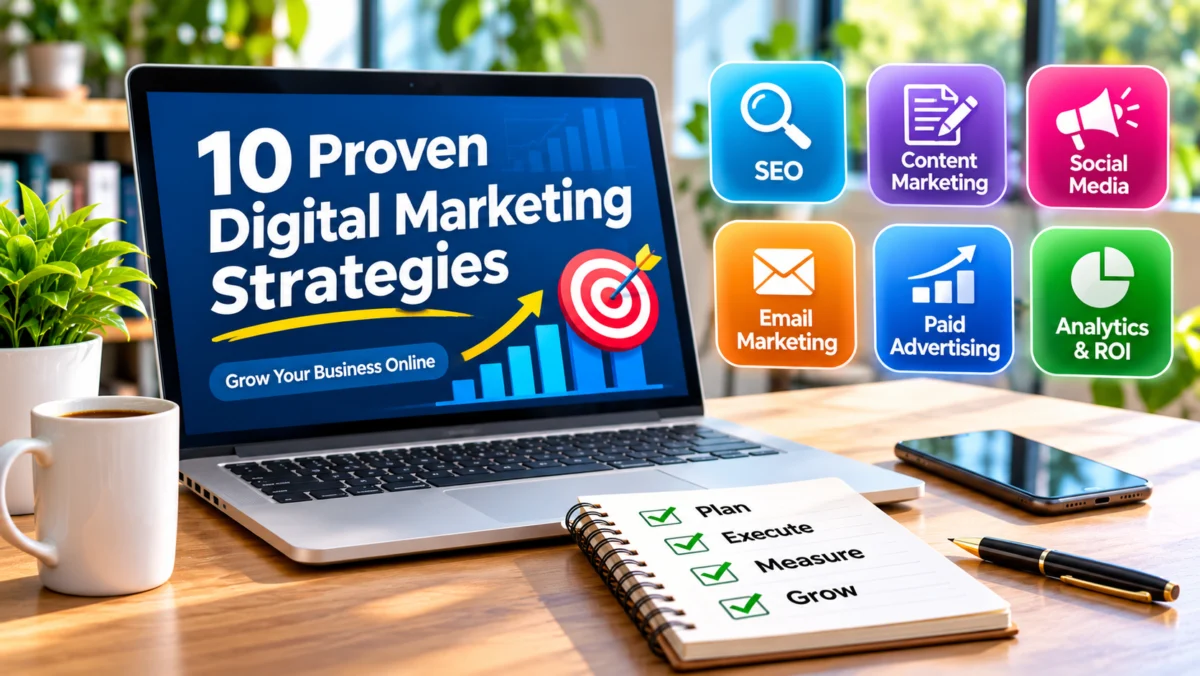
Start with the customer journey and one clear goal
Before choosing channels, map the steps a customer takes from discovering a need to buying and returning. At each stage, list the questions they ask and the proof they need.
| Journey stage | Customer question | Useful marketing activity |
|---|---|---|
| Awareness | What problem do I have and what options exist? | Search content, educational social posts, video and local discovery |
| Consideration | Which option fits my needs and budget? | Comparisons, demonstrations, reviews, case studies and detailed service pages |
| Conversion | How do I buy, book or contact the business? | Clear prices or quote steps, focused landing pages, calls to action and simple checkout |
| Retention | How do I get ongoing value or support? | Onboarding, email education, customer service, loyalty and useful follow-up |
Choose one primary business goal for the next planning period, such as qualified leads, purchases, booked appointments or repeat orders. Record the current baseline and decide which event or business record will prove that the goal has been reached.
1. Improve search visibility with SEO
Search engine optimization helps people find relevant pages when they are actively looking for information, products or services. SEO is a long-term channel: it requires useful content, accessible pages and ongoing maintenance rather than a one-time keyword update.
- Research the questions, problems and service terms your customers actually use.
- Create focused pages for important products, services and topics instead of combining unrelated subjects on one page.
- Write descriptive page titles, headings and meta descriptions that accurately reflect the page.
- Improve internal links so visitors and search engines can discover related pages.
- Check mobile usability, page speed, crawlability, indexing and broken links.
- Use Search Console to review query impressions, clicks, indexing issues and pages that need improvement.
Do not publish pages just to target slight variations of the same keyword. Every page should answer a distinct need and provide useful information. Google’s people-first content guidance emphasizes original, helpful information rather than content created primarily to manipulate rankings. For on-page tasks, read our guide to on-page SEO.
Useful measures: non-brand organic clicks, qualified organic leads, sales from organic landing pages, relevant search queries and the performance of priority pages.
2. Build a useful content marketing programme
Content marketing gives potential customers information that helps them understand a problem, compare solutions and use a product or service. A good content programme is based on customer questions and business expertise, not only on a publishing calendar.
Choose a manageable set of formats:
- How-to guides: explain a task or solve a common problem step by step.
- Comparisons: explain differences between options, including who each option suits and its limitations.
- Case studies: show a real challenge, the work completed and the outcome, with permission and accurate context.
- Checklists and templates: help readers apply the advice rather than simply read about it.
- Product or service explainers: answer questions about features, cost, setup, delivery and support.
Give each piece one intended audience, one purpose and one next step. Update content when facts, screenshots, pricing or processes change. AI tools can assist research and drafting, but verify claims and add original knowledge before publishing. Avoid producing large numbers of generic pages with little additional value.
Useful measures: engaged visits, return visits, qualified enquiries assisted by content, email sign-ups, content-assisted purchases and the performance of updated pages.
3. Use social media to build recognition and relationships
Choose social platforms based on where your customers spend time and what you can produce consistently. A B2B consultancy may benefit from expert posts and detailed case studies, while a consumer brand may use product demonstrations, community stories or short videos. A local business may prioritize useful location information and timely customer updates.

- Choose one or two primary platforms before expanding to others.
- Publish helpful tips, demonstrations, answers to common questions and credible behind-the-scenes content.
- Adapt the format and opening message to each platform instead of posting identical content everywhere.
- Reply to comments and messages with accurate information and a clear route to support.
- Get permission before reusing customer content and disclose paid or gifted partnerships.
Do not judge a social campaign only by follower growth. Track whether the activity reaches the intended audience and leads to useful site visits, enquiries, bookings or sales. Use platform analytics alongside website analytics, while remembering that views and clicks do not automatically mean a customer is ready to buy.
Useful measures: qualified reach, saves and shares, meaningful conversations, referral visits, leads and sales attributed to social campaigns.
4. Run paid search campaigns with clear controls
Paid search can put an offer in front of people who are actively looking for a product or service. It can also spend money quickly when the keywords, landing pages, conversion tracking or campaign settings are poorly matched.
Build campaigns around closely related services or products. Write specific ads, send users to a relevant landing page and make the next step easy to complete. Before increasing spend, check that the website records completed purchases, qualified enquiries or the other actions that matter to the business.
Google Ads AI Max is an optimization layer for Search campaigns. It can expand search-term matching, customize ad assets and use final URL expansion to direct traffic to relevant pages. These features require oversight: review search terms, brand suitability, geographic reach, generated copy and landing-page destinations. See Google’s AI Max explanation and setup guidance.
- Set a daily or campaign budget that the business can afford to test.
- Check search-term reports and exclude irrelevant queries where appropriate.
- Make sure ad claims match the landing page, offer and actual availability.
- Review lead quality and sales outcomes before increasing budgets.
- Record major setting changes so you can interpret performance correctly.
Useful measures: qualified leads, cost per qualified lead, completed purchases, customer acquisition cost, revenue and profit contribution after advertising and fulfilment costs.
5. Build an email marketing programme based on permission
Email is useful for onboarding, product education, service updates, event invitations and repeat-purchase communication. Its value comes from reaching people who have chosen to hear from the business and receiving messages that are relevant to their needs.
- Explain what subscribers will receive before they sign up.
- Use a clear consent process and keep records of preferences where required.
- Send a welcome message that sets expectations and provides a useful next step.
- Segment using relevant preferences or customer actions, not sensitive assumptions.
- Keep messages useful, readable on mobile and easy to unsubscribe from.
- Remove invalid addresses and monitor spam complaints and unsubscribes.
A simple welcome series might introduce the business, explain the most useful resources, answer common questions and invite the subscriber to take a relevant next step. Do not treat an email list as a collection of contacts to message without permission.
Useful measures: delivery rate, clicks, unsubscribe and complaint rates, qualified enquiries, repeat purchases and revenue per campaign. Open rates can be affected by privacy features and should not be treated as a complete measure of engagement.
6. Create video that demonstrates value
Video helps people see how a product works, understand a process or hear an expert explain a difficult topic. Match the format to the job: a short clip can answer one quick question, while a longer walkthrough can explain a product, service or comparison in more detail.
- Start with a genuine customer question or problem.
- Show the product, process or evidence instead of relying on claims alone.
- Use clear sound, accurate captions and a descriptive title.
- Include a useful next step, such as a related guide, product page or booking option.
- Provide text instructions or a transcript when the video contains important information.
For a small team, a smartphone, stable support and clear lighting can be enough for a first test. Focus on usefulness and clarity before investing in expensive production.
Useful measures: watch time, completion, saves, meaningful questions, click-through to relevant pages and conversions assisted by video.
7. Work with relevant creators and influencers
Creator partnerships can help a business reach a specific community and show its product or service in context. Choose partners for audience relevance, subject knowledge, credibility and content quality rather than follower count alone.
Before a campaign, agree on the intended audience, deliverables, schedule, fees or gifting, content approval, usage rights, exclusivity and performance measures. Give creators enough freedom to communicate naturally, but do not ask them to make claims they cannot support or present scripted endorsements as independent opinions.
Clearly disclose paid, gifted or otherwise material relationships according to the laws and platform rules that apply in the target market. Use trackable links or dedicated landing pages where practical. Evaluate qualified traffic, enquiries and sales rather than likes alone.
Useful measures: relevant reach, engagement quality, tracked visits, qualified leads, conversions, cost per acquired customer and reusable content value where usage rights permit.
8. Improve conversion rates on important pages
Conversion rate optimization (CRO) helps more of the right visitors complete an intended action. That action might be a purchase, contact form, appointment booking, quote request or newsletter sign-up.
- Make the main purpose of the page clear near the top.
- Match the landing page to the promise made in the advertisement, email or social post.
- Explain what happens after a visitor clicks or submits a form.
- Remove unnecessary form fields and checkout steps.
- Show relevant evidence such as real testimonials, clear policies, specifications or case studies.
- Check the complete experience on mobile, including error messages and confirmation pages.
Use analytics, customer feedback and session research to identify where visitors struggle. Test one meaningful change at a time where possible, and avoid declaring a winner from a very small number of conversions. Consider the quality of customers and the value of completed actions, not just the number of button clicks.
Useful measures: completed form or checkout rate, qualified conversion rate, form abandonment, revenue per visitor and lead-to-customer rate.
9. Build retention with useful follow-up and customer relationships
Long-term growth depends on keeping customers satisfied as well as acquiring new ones. Use onboarding, product education, service reminders, helpful support and relevant loyalty benefits to make the relationship more useful after the first purchase.
Collect only the customer information needed for a clear purpose. Respect communication preferences, protect records and provide a straightforward way to change or withdraw permissions. Retargeting can remind interested visitors about an offer, but use appropriate consent and platform controls, avoid excessive frequency and make the message relevant.
Review why customers stop buying or using a service. Feedback, support tickets, refund reasons and repeat-purchase patterns can reveal issues that more advertising will not fix.
Useful measures: repeat purchase rate, retention, churn, renewal rate, customer lifetime value, support satisfaction and revenue from existing customers.
10. Measure performance and improve the marketing mix
Choose a compact reporting set that links channel activity to business outcomes. The exact measures depend on your model, but most businesses should be able to explain how marketing contributes to leads, sales, revenue, customer acquisition cost and retention.
In Google Analytics 4, a key event is an action important to the success of the business, such as a purchase, enquiry or booking. Mark relevant events and test that they fire correctly. For advertising, review the conversion actions and reports in the platform as well. Analytics key events and advertising conversions serve related but distinct purposes. See Google’s guide to key events in Analytics.
Use consistent UTM parameters for campaign links and document changes to budgets, landing pages and tracking. Treat attribution reports as useful models rather than perfect proof that one channel caused every sale.
Basic calculations can make reports more useful:
- Cost per lead: campaign spend divided by the number of leads generated.
- Customer acquisition cost: relevant marketing and sales costs divided by the number of new customers acquired.
- Return on ad spend: attributed advertising revenue divided by advertising spend. This is a revenue ratio, not profit.
- Lead-to-customer rate: customers acquired divided by the leads in the same cohort or period.
For example, a campaign that spends ₹12,000 and generates 24 qualified leads has an advertising cost per qualified lead of ₹500. If six of those leads become customers, the campaign’s advertising spend per acquired customer is ₹2,000 before other sales, fulfilment and operating costs. Compare the result with gross margin and customer value before deciding whether to scale.
Useful measures: qualified leads, completed purchases, revenue, customer acquisition cost, contribution margin and repeat customer value.
Which strategies should your business prioritize?
Not every business needs all ten strategies at the same time. Start with the channel that best matches how customers discover and evaluate your offer, then connect it to a follow-up or retention activity.
| Business type | Good starting strategies | First test |
|---|---|---|
| Local service business | Local SEO, useful service content, reviews, call tracking and email follow-up | Improve one service page and measure qualified phone calls or quote requests |
| E-commerce store | Product SEO, demonstrations, paid search, email and conversion optimization | Improve one product page and measure completed purchases and margin |
| B2B company | Expert content, search, professional social media, email nurturing and case studies | Publish one detailed problem-solving guide and track qualified demo requests |
| New consumer brand | Creator content, short video, social discovery, email capture and measured paid tests | Test one creator partnership with a trackable landing page |
| Small publisher or content site | People-first SEO, original content, newsletters, social distribution and analytics | Refresh one high-value article and measure engaged visits and subscriptions |
A practical 90-day digital marketing action plan
Days 1–15: Set the baseline. Define the customer, offer and primary business goal. Review priority landing pages, analytics events, channel performance and customer feedback. Record the current number and quality of leads or sales.
Days 16–30: Fix the foundations. Improve the most important page, repair broken contact or checkout paths, check mobile usability and confirm conversion tracking. Choose one primary acquisition channel and one follow-up channel.
Days 31–60: Run controlled tests. Publish useful content, launch a small paid test or trial a creator/video campaign that fits the audience. Set an owner, budget, duration and success metric before launch. Avoid changing several major variables at once.
Days 61–90: Review and reallocate. Compare results with the baseline. Keep activities that produce qualified outcomes at an acceptable cost. Improve or stop campaigns that attract attention but not useful customers. Plan the next cycle using what you learned.
Common digital marketing mistakes to avoid
- Trying to use every channel before understanding where customers actually discover the business.
- Buying traffic before the offer, landing page and conversion tracking are ready.
- Publishing generic content that does not answer a real customer question.
- Measuring followers, impressions or clicks without checking lead quality and sales.
- Using purchased email lists, fake reviews, undisclosed endorsements or manipulative links.
- Increasing ad spend before understanding acquisition cost, margins and fulfilment capacity.
- Changing multiple campaign elements at once and then guessing which change caused the result.
Frequently asked questions
Which digital marketing strategy should a small business start with?
Start with the channel closest to customer intent and the one the business can maintain. A local service business may begin with a useful website, local search and lead tracking. An online store may begin with strong product pages, email capture and a small measured advertising test.
Do businesses need both SEO and paid advertising?
Not necessarily. SEO can build search visibility over time, while paid advertising can create exposure while a campaign is running. Choose the mix based on urgency, margins, competition and resources. Both need useful landing pages and measurement.
How much should a business spend on digital marketing?
There is no universal budget. Start with an amount the business can afford to test, define what a qualified result is and understand the cost of serving a new customer. Increase spending only when lead quality, conversion and margin support it.
How long does digital marketing take to show results?
Some paid campaigns can generate visits soon after launch, but profitable results depend on the offer and conversion experience. SEO, content and customer relationships usually need sustained work. Judge each channel over a period that fits its buying cycle and available data.
How often should a marketing strategy be reviewed?
Monitor campaigns regularly for errors and unusual changes. Review the channel mix and budget at planned intervals after enough reliable data has accumulated. Use customer feedback, costs, sales outcomes and market changes to guide decisions.
Related digital marketing guides
If you are new to the subject, begin with Digital Marketing for Beginners. For AI applications and safeguards, read How AI Is Transforming Digital Marketing. You can also explore our overview of digital marketing trends businesses should prepare for.
5 thoughts on “10 Digital Marketing Strategies for Sustainable Growth”